More apps, same downloads: why design sets an app apart in 2026
About 560,000 new apps reached the App Store in H1 2026 while downloads grew 2 percent. What the numbers show, what Apple enforces, and where design decides.

On this page
In the first half of 2026, about 560,000 new apps reached the App Store, roughly twice as many as a year earlier, while App Store downloads grew 2 percent to 17.6 billion, according to Sensor Tower estimates reported by The New York Times. When code costs almost nothing, supply grows and demand stays where it was. What a person can tell apart in a search result and in the first minute of use is the design, and that is where a design system earns its place.
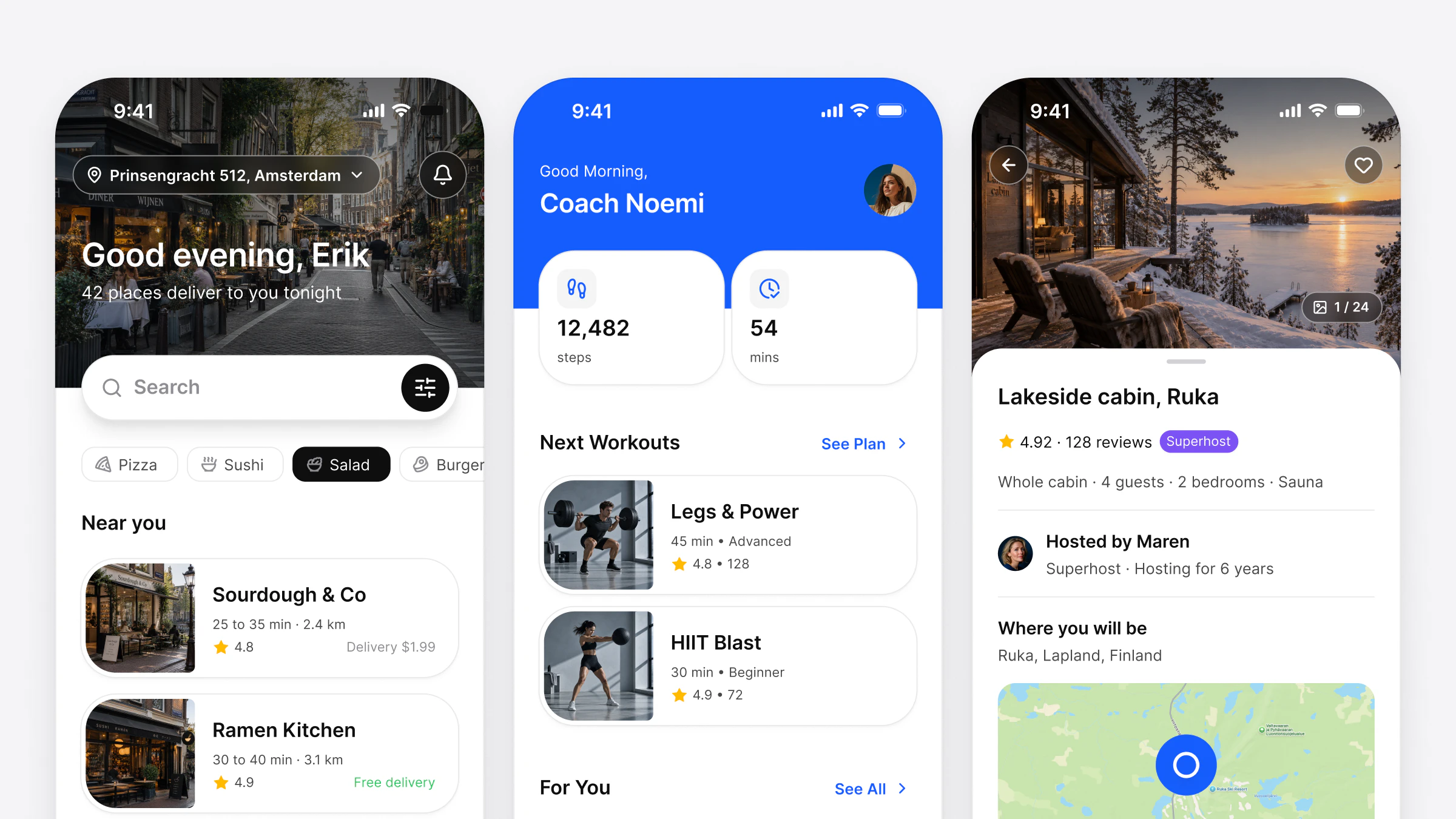
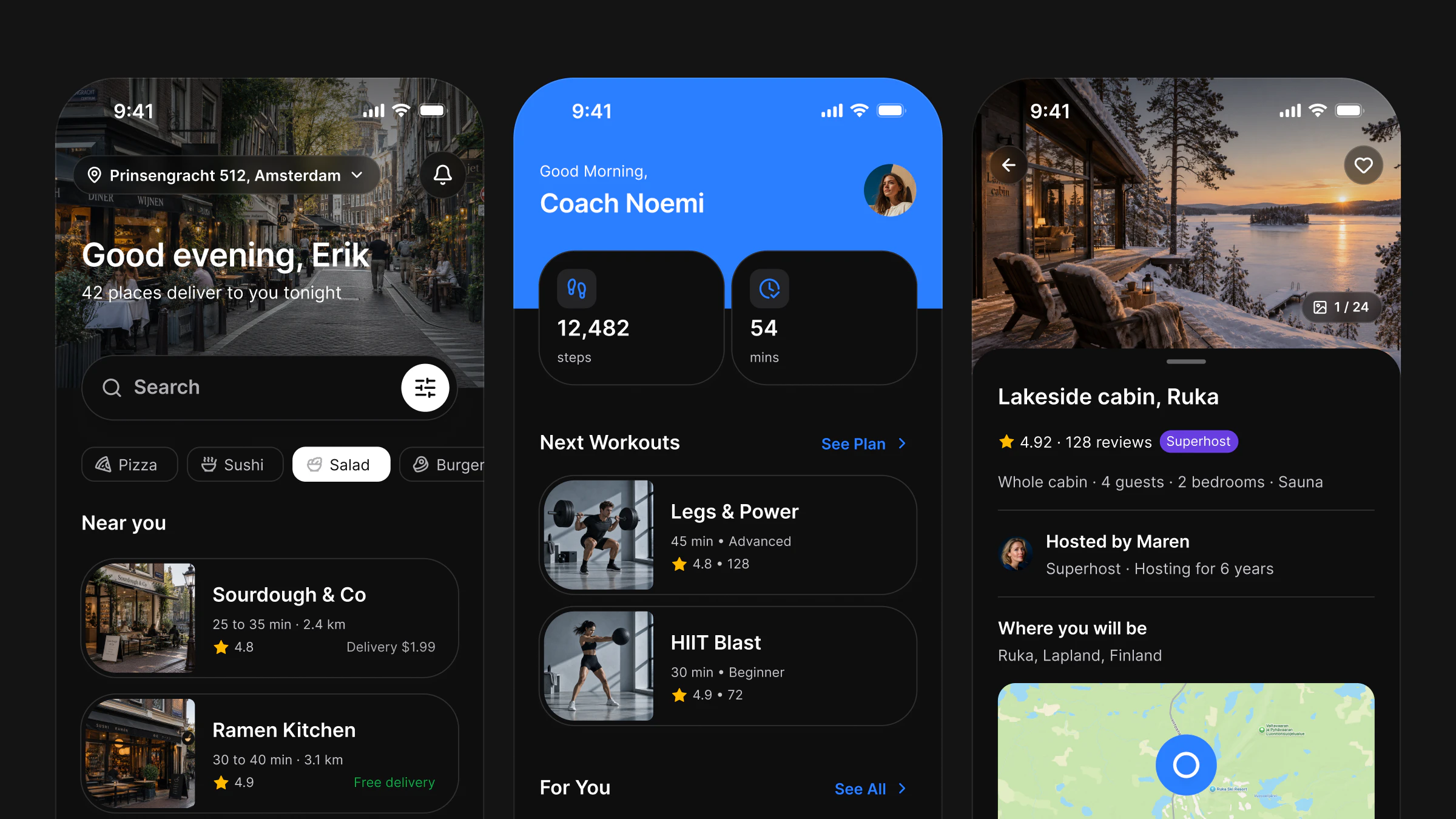
Appetite UI is a Figma UI kit for iOS and Android apps, built like a design system. One token source drives Apple and Material components in light and dark mode, and exports to SwiftUI, Jetpack Compose, Flutter and CSS. I make it, and the second half of this article uses its files to show what makes a generated screen read as designed.
The App Store added almost as many apps in six months as in all of 2025.
Two analytics firms, a newsroom and Apple itself counted the surge, and they count different things. Sensor Tower and Appfigures estimate new apps released. Apple counts submissions to App Review, which include updates and every resubmission after a rejection. Read each number with its own definition.
In 2025, the number of new apps released on the App Store grew 30 percent to about 600,000, according to Sensor Tower estimates reported by The New York Times on July 20, 2026. In the first half of 2026, that number doubled to about 560,000, almost the whole of the previous year in six months. The same report puts the peak in 2016, at about 890,000 new apps, and the low in 2022, at about 420,000.
- New apps in 2025, up 30%
- About 600,000
- New apps in H1 2026, double the year before
- About 560,000
- Downloads in H1 2026, up 2%
- 17.6 billion
The quarter before gave the first signal. The App Store saw 235,800 new apps in the first quarter of 2026, up 84 percent from the first quarter of 2025, according to data published by The Information and reported by Gizmodo on April 6, 2026. Appfigures measured the same quarter on its own: app releases rose 60 percent year over year across the App Store and Google Play, and 80 percent on the App Store alone, as TechCrunch reported on April 18, 2026.
| Measure | Period | Number | Source |
|---|---|---|---|
| New apps released on the App Store | 2025 | About 600,000, up 30% | Sensor Tower estimates, via The New York Times |
| New apps released on the App Store | H1 2026 | About 560,000, double the year before | Sensor Tower estimates, via The New York Times |
| New apps on the App Store | Q1 2026 | 235,800, up 84% year over year | The Information, via Gizmodo |
| App releases on the App Store | Q1 2026 | Up 80% year over year | Appfigures, via TechCrunch |
| App Store downloads | 2025 | 35.4 billion, up 3% | Sensor Tower estimates, via The New York Times |
| App Store downloads | H1 2026 | 17.6 billion, up 2% | Sensor Tower estimates, via The New York Times |
| App submissions reviewed | 2024 | 7,771,599 | Apple, 2024 App Store Transparency Report |
| App submissions reviewed | 2025 | 9,100,620 | Apple, 2025 App Store Transparency Report |
| App submissions rejected | 2025 | 2,093,244 | Apple, 2025 App Store Transparency Report |
| Rejections under Design | 2024 | 378,300 | Apple, 2024 App Store Transparency Report |
| Rejections under Design | 2025 | 415,532 | Apple, 2025 App Store Transparency Report |
| Submissions that copied other apps, were spam or misled users | 2025 | Over 371,000 | Apple Newsroom, May 20, 2026 |
| MCP weekly active users in Figma Design | Q1 2026 | Five times the previous quarter | Figma, Q1 2026 results |
Sensor Tower and Appfigures publish estimates, and the two firms count new apps differently, so their percentages are not interchangeable. Apple's submissions include updates and resubmissions. Every source is linked under Sources.
New apps doubled while downloads grew 2 percent.
Set the two Sensor Tower lines side by side. In 2025, new apps grew 30 percent and downloads 3 percent. In the first half of 2026, new apps doubled and downloads grew 2 percent, to 17.6 billion. In both periods, new apps grew at least ten times faster than downloads.
Growth year over year, new apps and downloads
What the numbers show is a gap. What they do not show matters as much. No source counts how many of the new apps were vibe coded, that is, built mostly by describing them to an AI agent. TechCrunch, reporting the Appfigures data, called the link a "working hypothesis": that "AI-powered tools, like Claude Code or Replit, could be behind the surge of new launches." Apple came closest to saying it outright. Its fraud prevention release of May 20, 2026 says, in a paragraph on App Review, that "AI development tools drive a surge in app submissions".
The numbers also do not say that each new app earns fewer downloads, since no source here counts downloads per new app. And they do not say that a better looking app wins. They say the shelf grew much faster than the number of people taking things off it, and every new app now meets more apps beside it in the same search.
Apple reviewed 1.3 million more submissions in 2025 than in 2024.
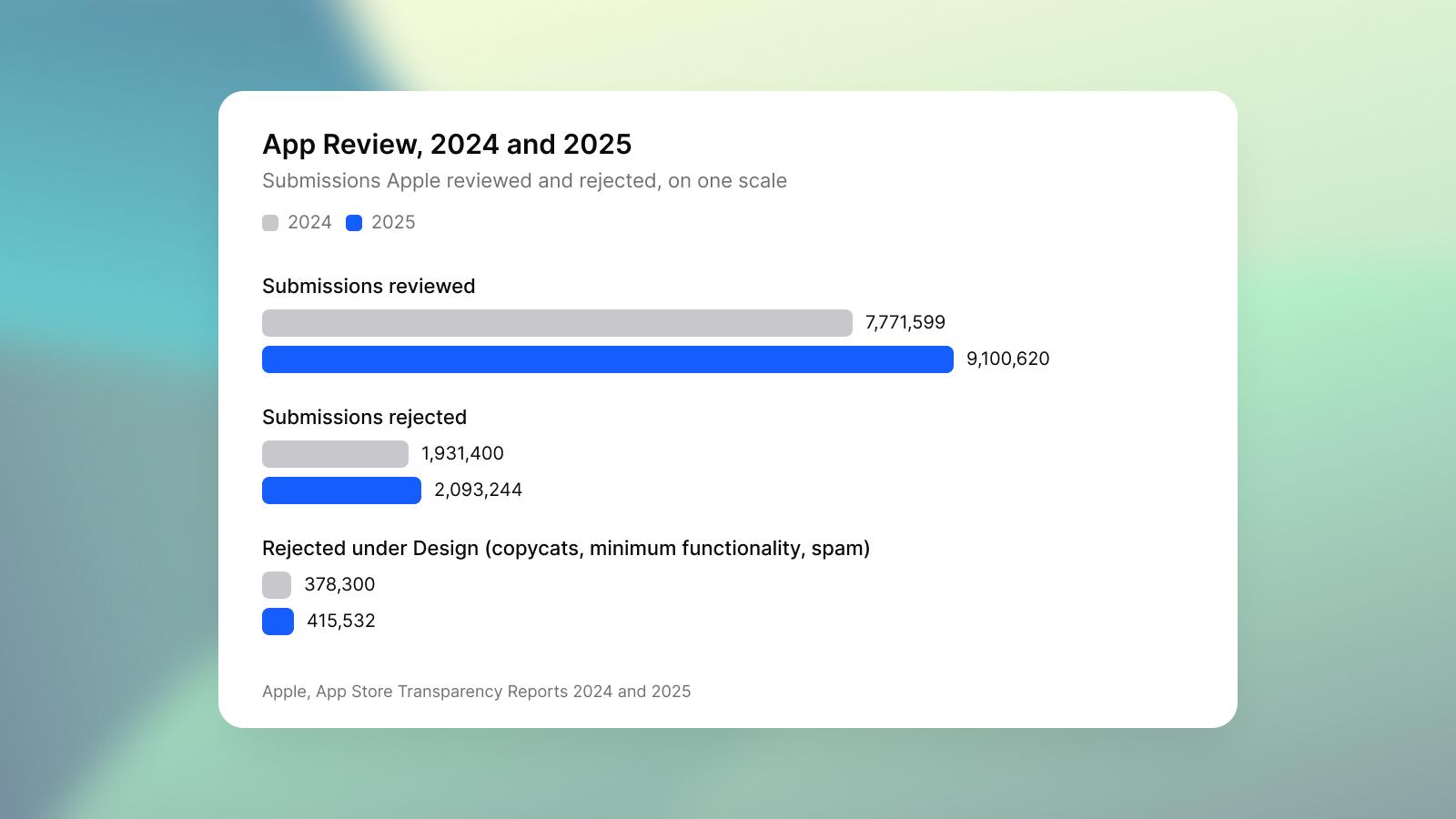
Apple's own counts cover 2025, before most of the surge Sensor Tower measured. Apple reviewed 9,100,620 app submissions in 2025, against 7,771,599 in 2024, according to its App Store Transparency Reports for the two years. By my arithmetic on the two reports, that is a 17 percent rise.
The rise did not start in 2025. Apple's reports for 2022 and 2023 count 6,101,913 and 6,892,500 submissions reviewed, and 1,679,694 and 1,763,812 rejected, so the yearly increase in submissions went from about 13 percent in 2023 and in 2024 to 17 percent in 2025, by the same arithmetic.
App submissions Apple reviewed and rejected, millions
- Submissions reviewed 9,100,620 in 2025
- Submissions rejected 2,093,244 in 2025
| Period | Submissions reviewed | Submissions rejected |
|---|---|---|
| 2022 | 6.1 M | 1.68 M |
| 2023 | 6.89 M | 1.76 M |
| 2024 | 7.77 M | 1.93 M |
| 2025 | 9.1 M | 2.09 M |
Apple rejected 2,093,244 of the 2025 submissions. In its fraud prevention release, Apple split the rejections into more than 1.2 million new apps and nearly 800,000 app updates. The share rejected fell slightly, from about 25 percent in 2024 to about 23 percent in 2025, again by my arithmetic on Apple's numbers.
The section worth reading for this article is Design. Apple rejected 415,532 submissions under it in 2025 and 378,300 in 2024, after 295,497 in 2023 and 212,464 in 2022, so the Design count almost doubled in three years. A footnote in the 2024 and 2025 reports defines it: "The Design category includes guidelines that prohibit copycat apps, apps with minimum functionality, and spam." The fraud release adds that Apple stopped "over 371,000 submissions that copied other apps, were found to be spam, or otherwise misled users" in 2025.
Removals for these reasons stay small next to rejections. The 2025 report lists 418 apps removed under guideline 4.3.0, Spam, and 279 under 4.1.0, Copycats. Most of the filtering happens at the door. Apple's spokesman Peter Ajemian told The New York Times that Apple "consistently reviewed 90% of app submissions within 48 hours". Apple's report on 2026, the year of the surge, has not been published yet.
Apple's guidelines already ask an app to be more than another copy.
Three guidelines frame what a flood of similar apps runs into, and none of them was written for AI. Guideline 4.2, Minimum Functionality, opens: "Your app should include features, content, and UI that elevate it beyond a repackaged website." Note the word UI in that sentence.
Guideline 4.3, Spam, is more direct. Part (b) reads: "Don't submit apps that are indistinguishable from what's already widely available." It goes on to name categories Apple considers saturated, among them flashlight, wallpaper and simple timers, and says it "will not accept new submissions unless they offer a meaningfully different or improved experience."
Guideline 2.5.2 is the one Apple applied to the AI tools themselves. It says apps may not "download, install, or execute code which introduces or changes features or functionality of the app, including other apps." The Decoder, citing The Information, reported on March 18, 2026 that Apple had blocked updates of the vibe coding apps Replit and Vibecode under this rule, and that Apple said the rule does not specifically target vibe coding apps. The rule governs the builder app. The apps people build with it face 4.2 and 4.3 like everyone else.
The introduction to the Design section states the standard behind all three: "Apple customers place a high value on products that are simple, refined, innovative, and easy to use, and that's what we want to see on the App Store."
A store listing is a set of pictures of your interface.
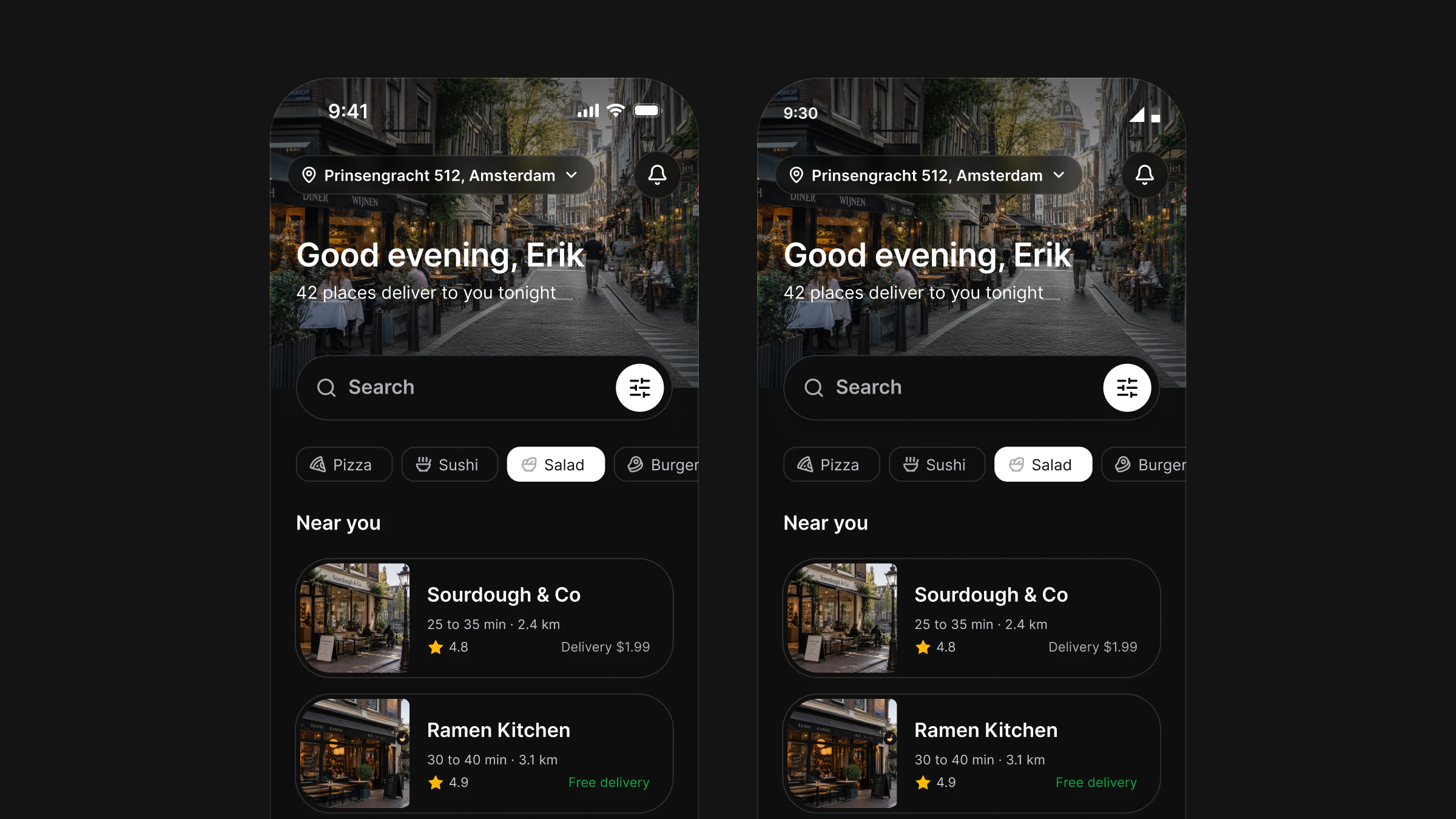
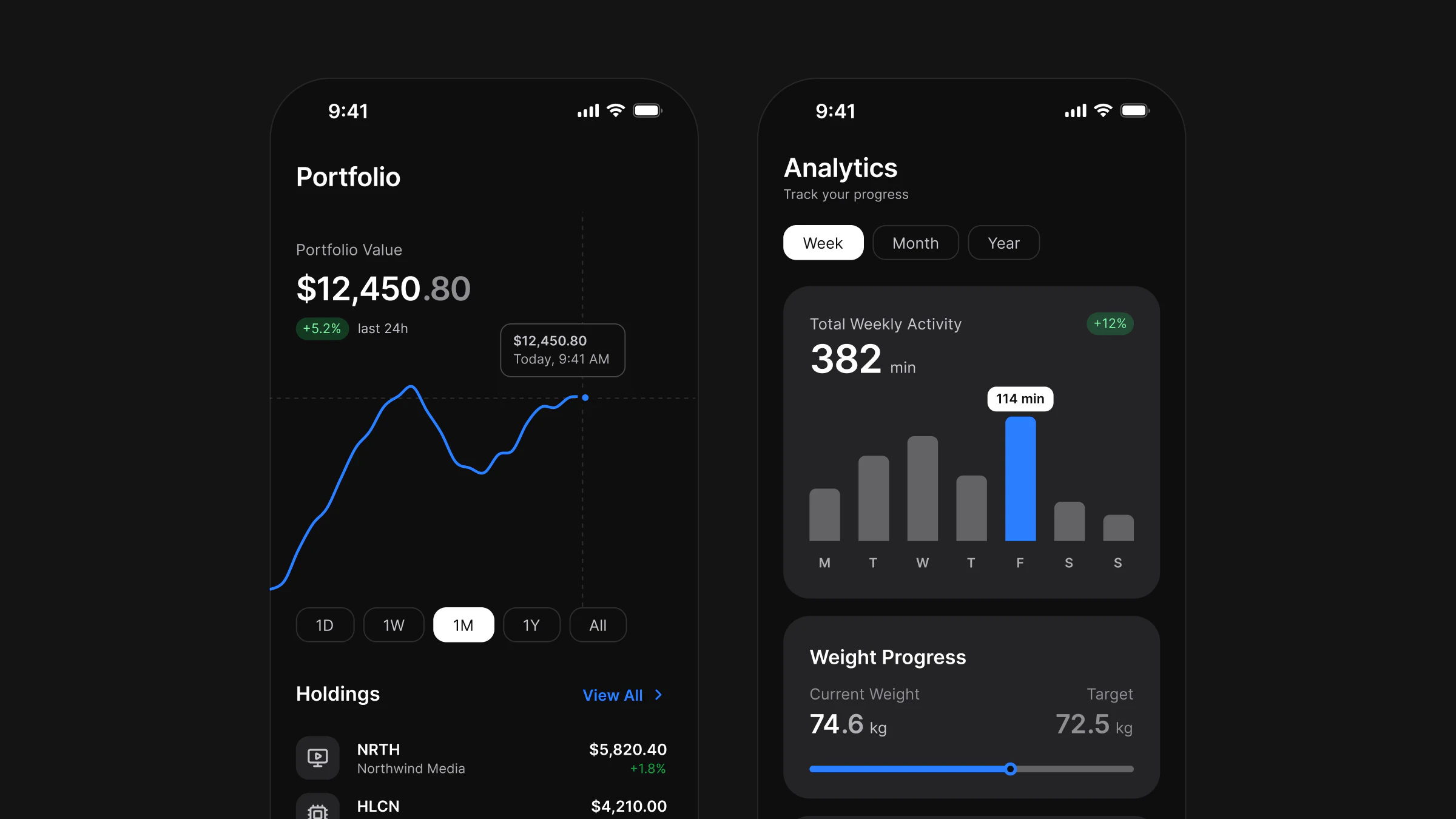
Before anyone downloads an app, they see it in a search result. Apple's guidance for product pages explains what that result shows: "Depending on the orientation of your screenshots, the first one to three images will appear in search results when no app preview is available, so make sure these highlight the essence of your app." It asks for "images captured from your app's UI", and adds: "If your app supports Dark Mode, consider including at least one screenshot that showcases what the experience looks like for users."
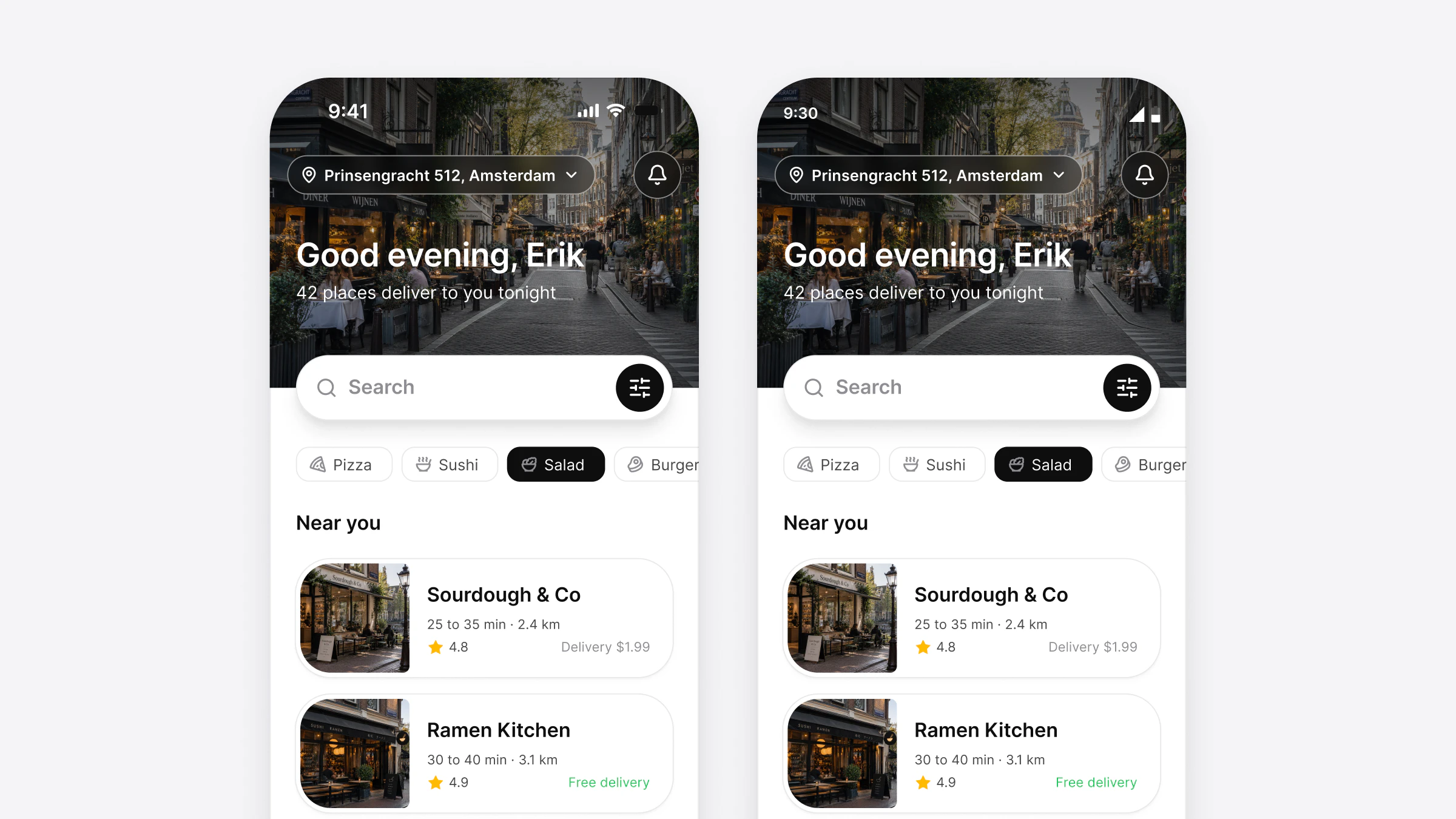
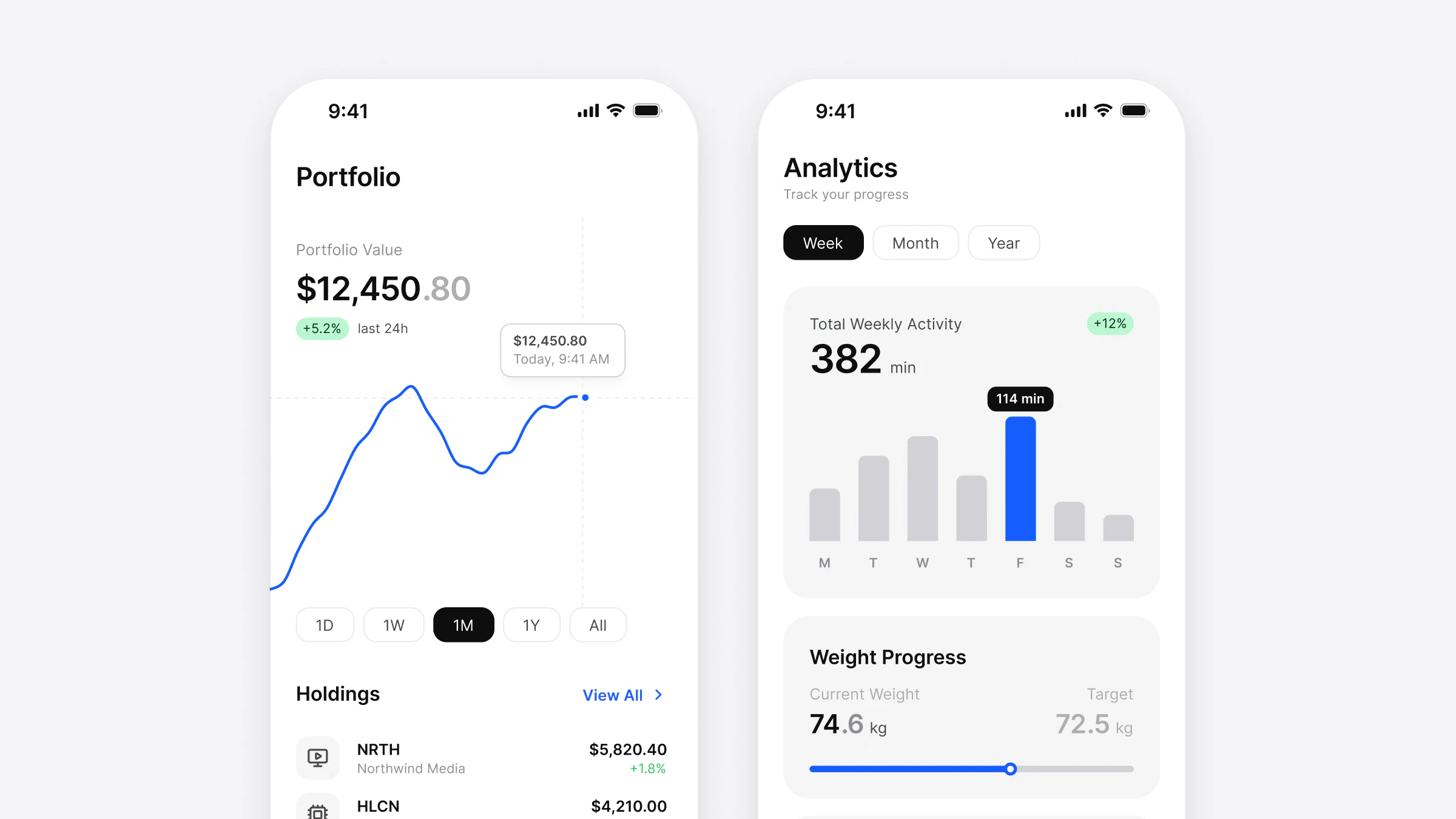
So the first comparison a person makes between your app and the one next to it is a comparison of interfaces. The code is invisible there. The feature list is a line of text. What differs at a glance is color, type, spacing, the shape of the controls and whether the screen looks like it belongs on the phone in the person's hand. When two apps were generated from the same defaults, those are exactly the parts that match. Why vibe-coded apps all look the same traces where those defaults come from.
The first minute after the download works the same way. A person who opens the app has not used its features yet. They see a screen, tap a control, maybe switch the phone to dark mode, and decide whether to stay.
A generated screen reads as designed when every value is a named decision.
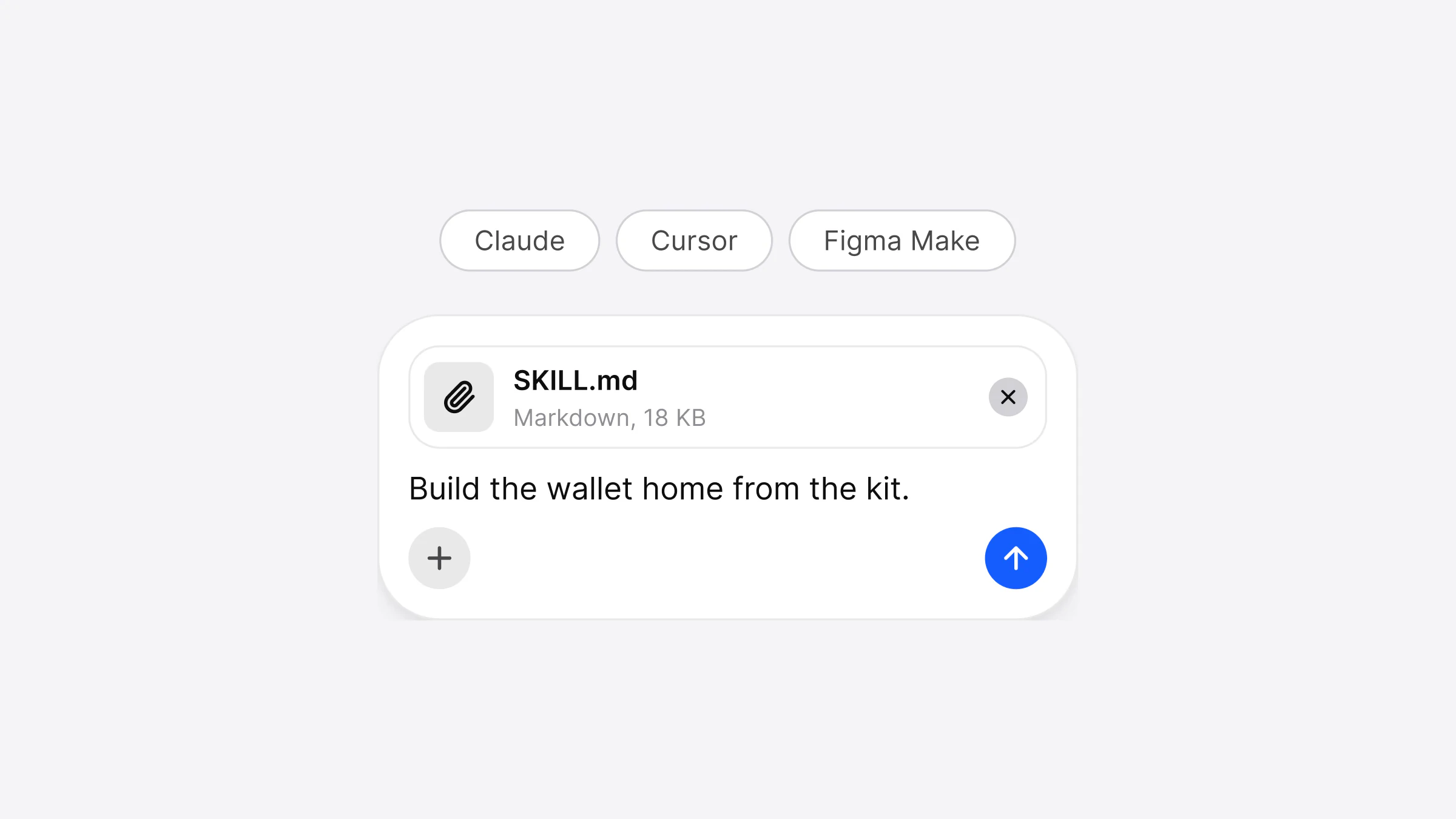
This is where my own work comes in. Appetite UI ships an instruction file for agents, the Core Skill, at skills/appetite-core/SKILL.md in the Figma file you buy. It opens with three sentences: "You are building inside a system. The values are already decided. Your job is to pick the right one, not to invent a new one."
The rules after it turn that into checks an agent can follow. Apply semantic tokens such as brand/base and text/strong-950, never a typed hex. Take every size from the 4 point scale, where spacing/6 is 24. Take every radius from the radius scale: buttons are full capsules, cards take 2xl. Take every text setting from the 20 text styles. And bind both modes: "If you typed a value, dark mode is already broken."
Light and dark sit on one token, so the dark mode screenshot Apple suggests is the same screen with its mode switched. This is brand/base as the public /tokens.json carries it, its description left out:
"base": {
  "$type": "color",
  "$value": "#155DFC",
  "$extensions": {
    "com.appetiteui": {
      "collection": "Color Tokens",
      "modes": { "light": "#155DFC", "dark": "#2B7FFF" },
      "aliases": { "light": "colors/blue/500", "dark": "colors/blue/400" },
      "codeSyntax": {
        "web": "var(--ap-brand-base)",
        "ios": "Color.apBrandBase",
        "android": "AppetiteTheme.colors.brandBase"
      }
    }
  }
}
The platform is the other half of looking like you belong on the phone. The Core Skill's twelfth rule tells the agent to take the pattern from the platform. A primary action goes in the bottom toolbar or in content on iOS and in a floating action button on Android. A choice of actions is an action sheet on iOS and a Modal Sheet or a menu on Android. Transient feedback is a toast without an action on iOS and a snackbar with one action on Android. How to design one app for iOS and Android in Figma shows the same split in the Figma file.
The second skill in the package, the slop linter, checks the result. Its first line names what it looks for: "Generated UI drifts. Seven shades of blue, spacing that follows no scale, a 14px radius next to a 12px one, iOS patterns on Android." I replaced Figma Code Connect with the Core Skill in release 2.3 because a mapped code snippet never decided any of those values, and they are the values a screenshot shows. How Appetite UI works with AI agents walks through the setup.
Since November 8, 2026 the components also exist as code. Appetite UI Code has 41 of them in React Native, and SwiftUI, Flutter and Jetpack Compose start with 15, with an App Starter and an agent kit. The agent kit is a CLAUDE.md, an AGENTS.md, a Cursor rules file and a skill that maps each Figma property to a prop, and it extends the Core Skill rather than repeating it. The Core Skill and the slop linter come with the Figma file, the agent kit with Code.
An agent can read the system before anyone buys it.
Agents already work inside design files. Figma reported that in the first quarter of 2026, "MCP weekly active users in Figma Design grew five times quarter-over-quarter", in its results release of May 14, 2026. An agent that reads a frame still needs to know which values the frame was built from.
Appetite UI publishes the readable part as text. /llms.txt lists the docs and product pages with a line on each, and /llms-full.txt holds every docs page in one file. Every docs page has a Markdown twin at its URL plus .md, such as /docs/button.md. /tokens.json is grouped by the Figma variable paths, brand.base, bg.weak-50, colors.blue.500, and carries the light and dark value and the web, iOS and Android code name of each token in its $extensions, the same shape as the tokens.json in the package. It holds the tokens the docs previews draw.
The full token source, its SwiftUI, Compose, Flutter and CSS outputs, the Core Skill, AGENTS.md and the slop linter come with the Figma file, listed on pricing. If you are weighing kits for this kind of work, The best Figma UI kits for mobile apps in 2026 compares the options, and how to vibe code a mobile app walks through the rest of the setup, from the stack to the store review. To see the whole system before deciding, open the read-only Figma preview, or start with the AI page, which runs one prompt through the Core Skill and shows each token the agent picked.
Questions
How many new apps were added to the App Store in 2026?
About 560,000 new apps were released on the App Store in the first half of 2026, about double the year before, according to Sensor Tower estimates reported by The New York Times on July 20, 2026. For the first quarter alone, The Information reported 235,800 new apps, up 84 percent year over year.
Did App Store downloads grow with the number of new apps?
No. App Store downloads grew 2 percent to 17.6 billion in the first half of 2026, while new apps doubled, according to Sensor Tower estimates reported by The New York Times. In 2025, downloads grew 3 percent to 35.4 billion while new apps grew 30 percent.
Are the new App Store apps vibe coded?
Nobody has counted. Apple's fraud prevention release of May 20, 2026 says AI development tools drive a surge in app submissions, and TechCrunch, reporting Appfigures data, called AI coding tools a working hypothesis for the rise. No source measures how many new apps were built with them.
Which App Review guidelines apply to vibe-coded apps?
The same guidelines as to every app. Guideline 4.2 asks for features, content and UI beyond a repackaged website, 4.3 rejects apps "indistinguishable from what's already widely available", and 4.1 covers copycats. Apple applied guideline 2.5.2, on apps that execute code which changes their functionality, to vibe coding builder apps such as Replit and Vibecode.
Does a design system get an app through App Review?
No. App Review checks an app against the guidelines, and no kit decides that. A design system decides how every screen of the app looks and behaves in light and dark and on each platform, which is what a search result and the first minute of use show.
Sources
- read October 7, 2026The Star (reprinting The New York Times), 'Vibecoded' apps are flooding the App Store. Is that good for Apple?
- 9to5Mac, Report, read October 7, 2026App Store added nearly as many new apps in H1 2026 as in all of 2025
- read October 7, 2026Gizmodo, Apple App Store experiences surge in new apps amid vibe coding boom
- read October 7, 2026TechCrunch, The App Store is booming again, and AI may be why
- read October 7, 2026Apple, 2025 App Store Transparency Report
- read October 7, 2026Apple, 2024 App Store Transparency Report
- read October 7, 2026Apple Newsroom, The App Store stopped over $2.2 billion in potentially fraudulent transactions in 2025
- read October 7, 2026Apple Developer, App Review Guidelines
- read October 7, 2026Apple Developer, Creating your product page
- read October 7, 2026The Decoder, Apple reportedly blocks vibe-coding apps from publishing updates
- read October 7, 2026Figma, Figma Announces First Quarter 2026 Financial Results
- read November 13, 2026Apple, 2023 App Store Transparency Report
- read November 13, 2026Apple, 2022 App Store Transparency Report